Diffusion Models Intro Slides
First published: 2026-11-18 · Last content update: 2026-11-18
15 slides on learning and sampling, Flow Matching, diffusion, and guidance.
The original slide layout and page numbers are preserved. Play the three animated demonstrations using the video controls below their slides. The PDF contains still frames. Select any slide to view it at full size. See the references and reading guide for sources grouped by topic.
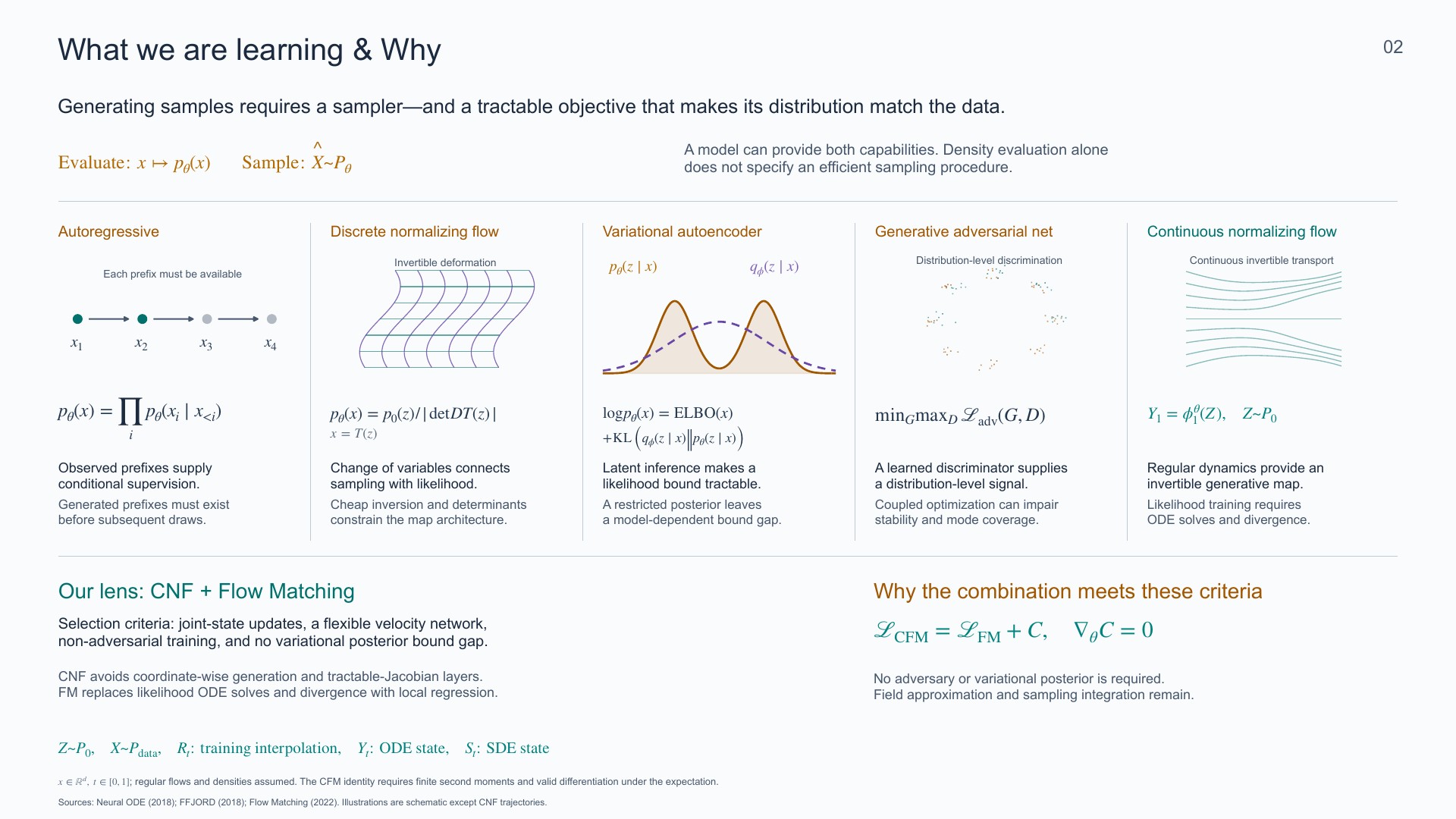
1. What we are learning & Why
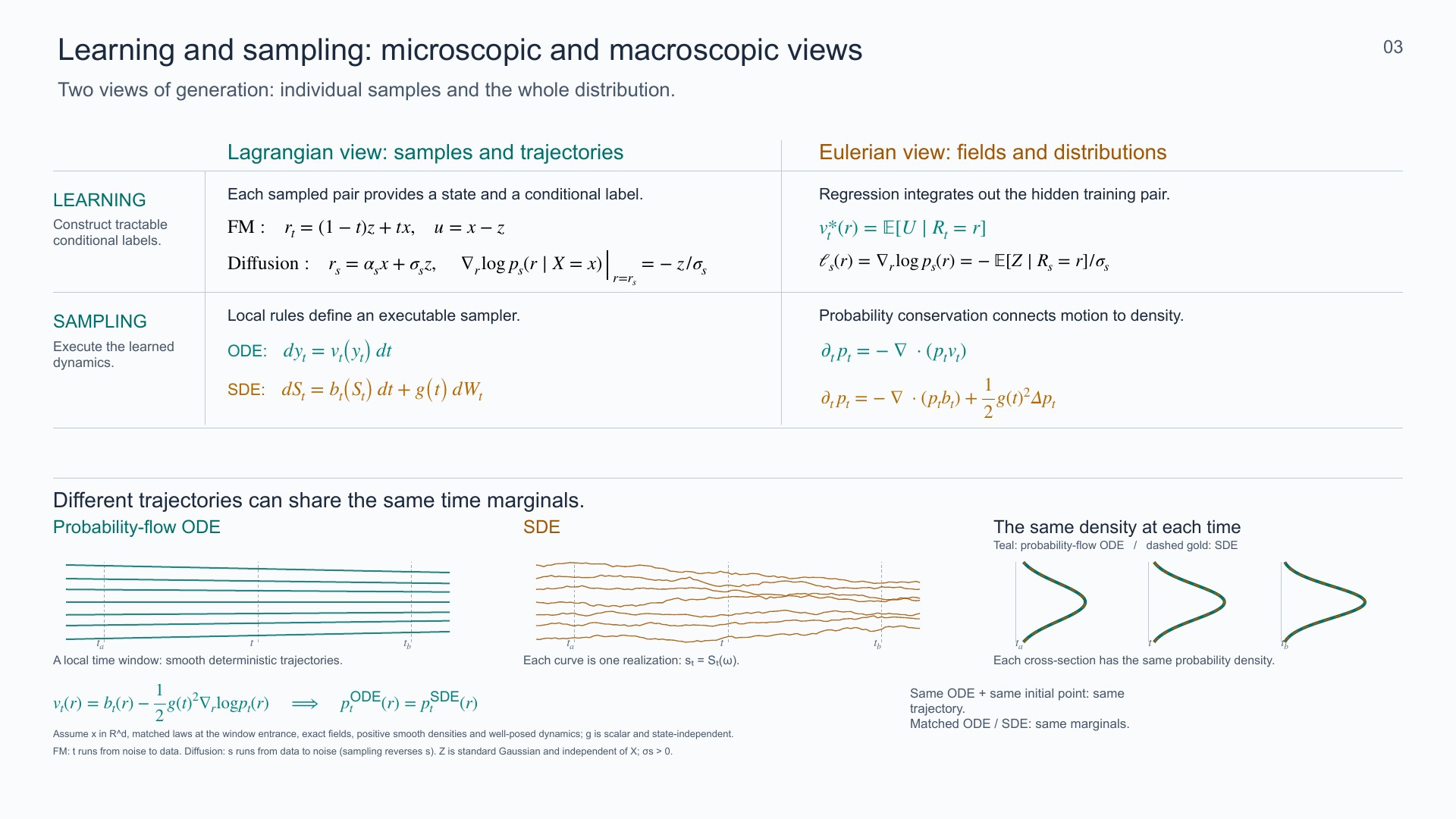
2. Learning and sampling: microscopic and macroscopic views
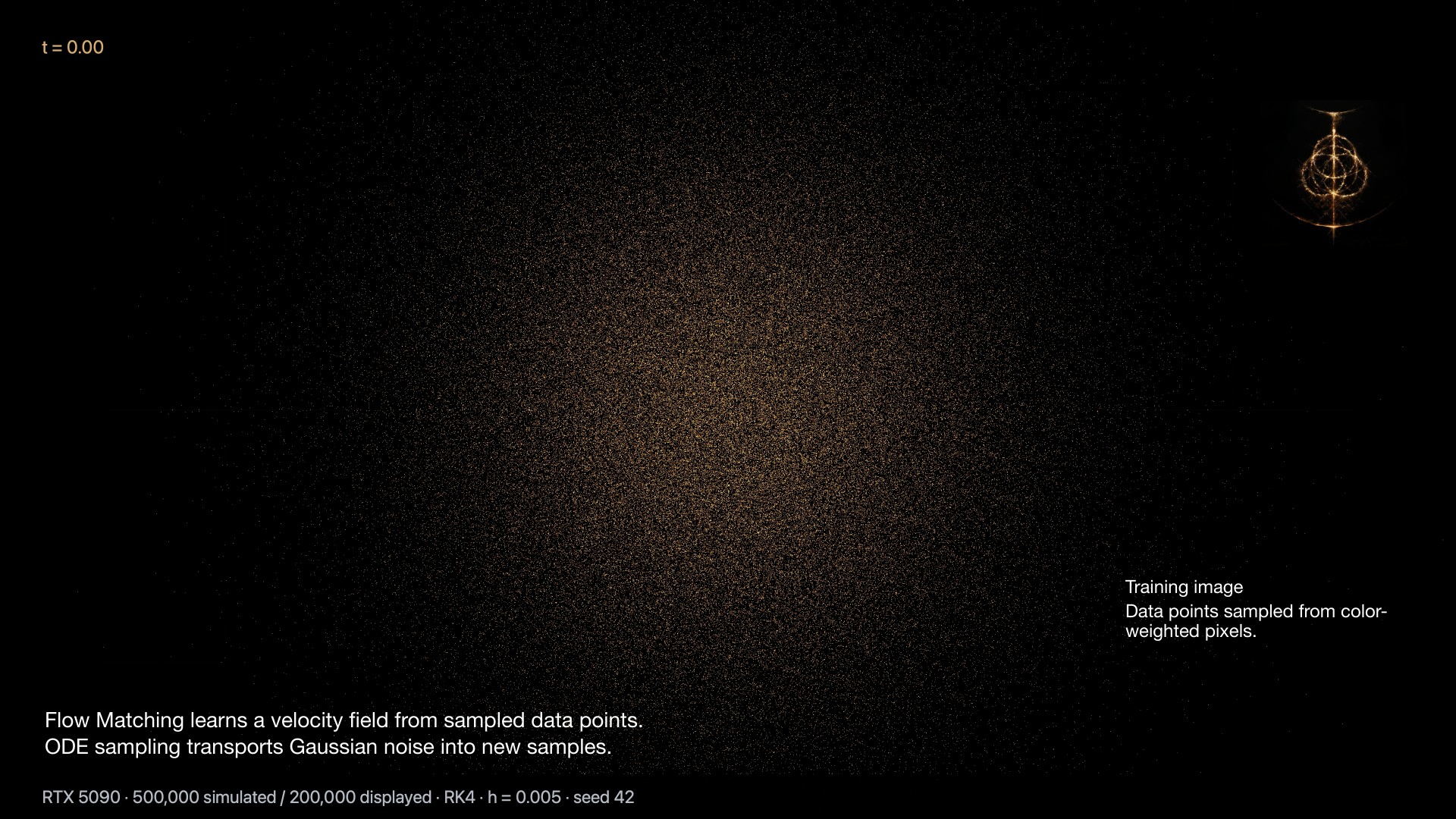
3. Flow Matching sampling demonstration
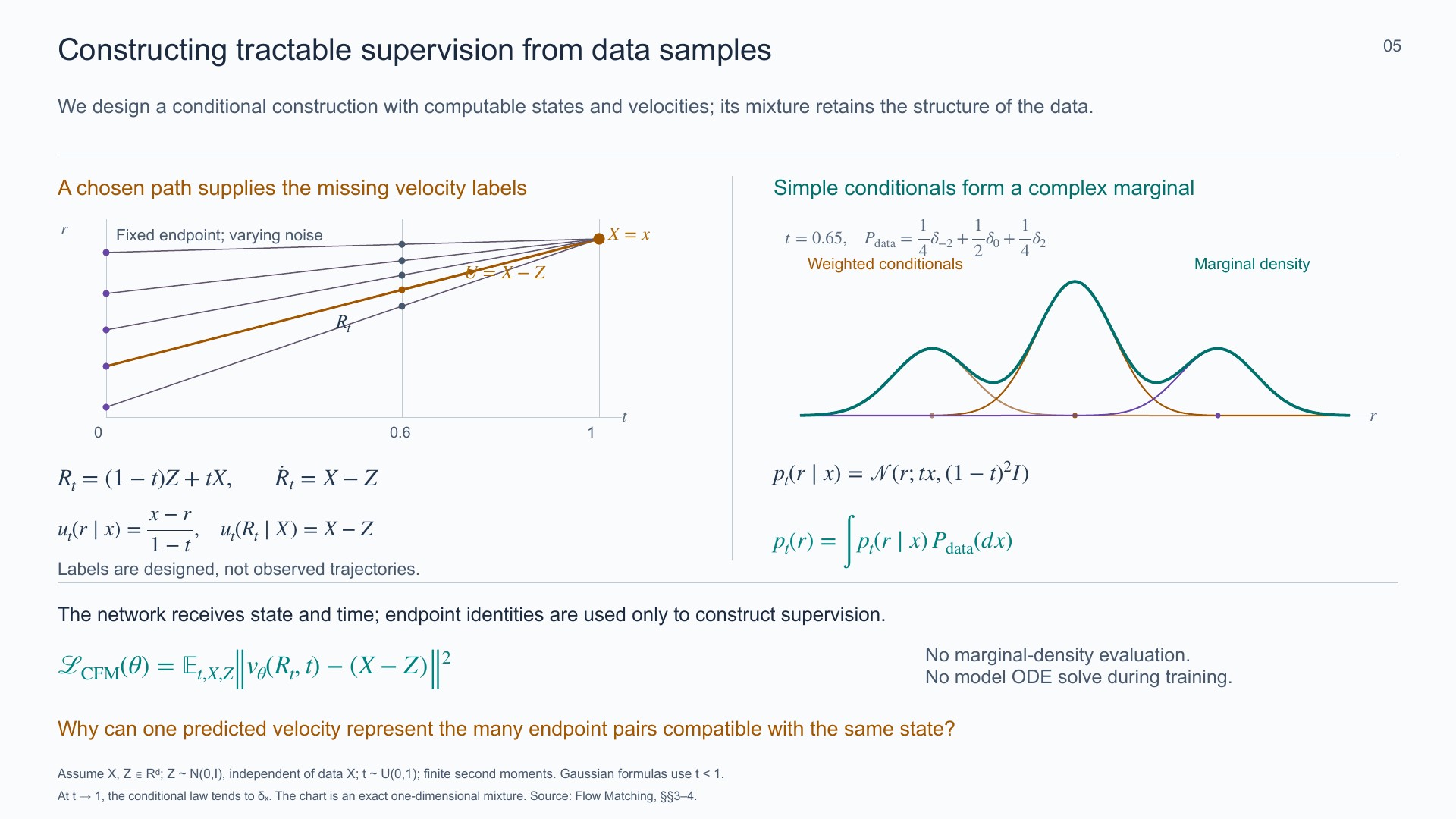
4. Constructing tractable supervision from data samples
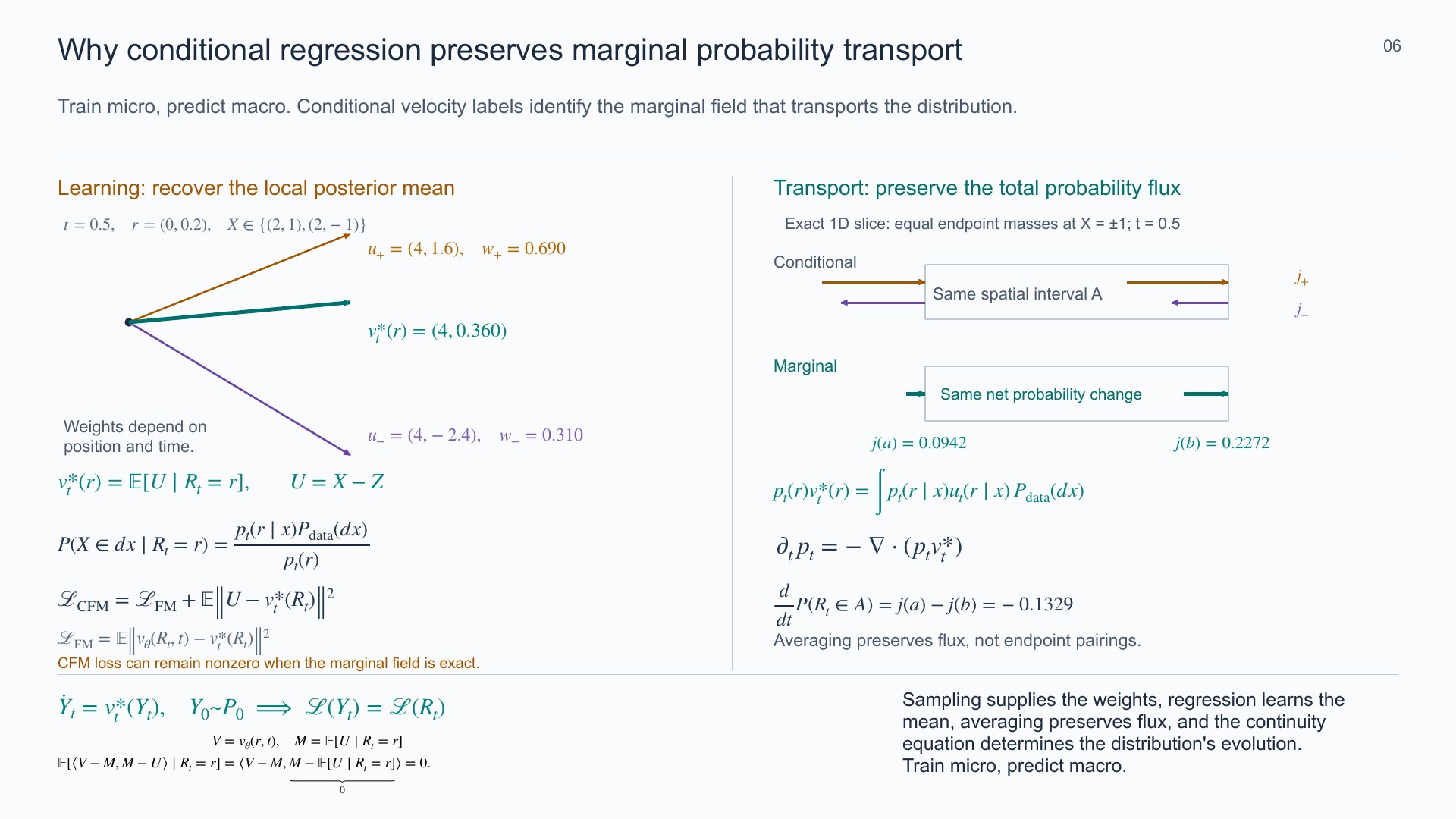
5. Why conditional regression preserves marginal probability transport
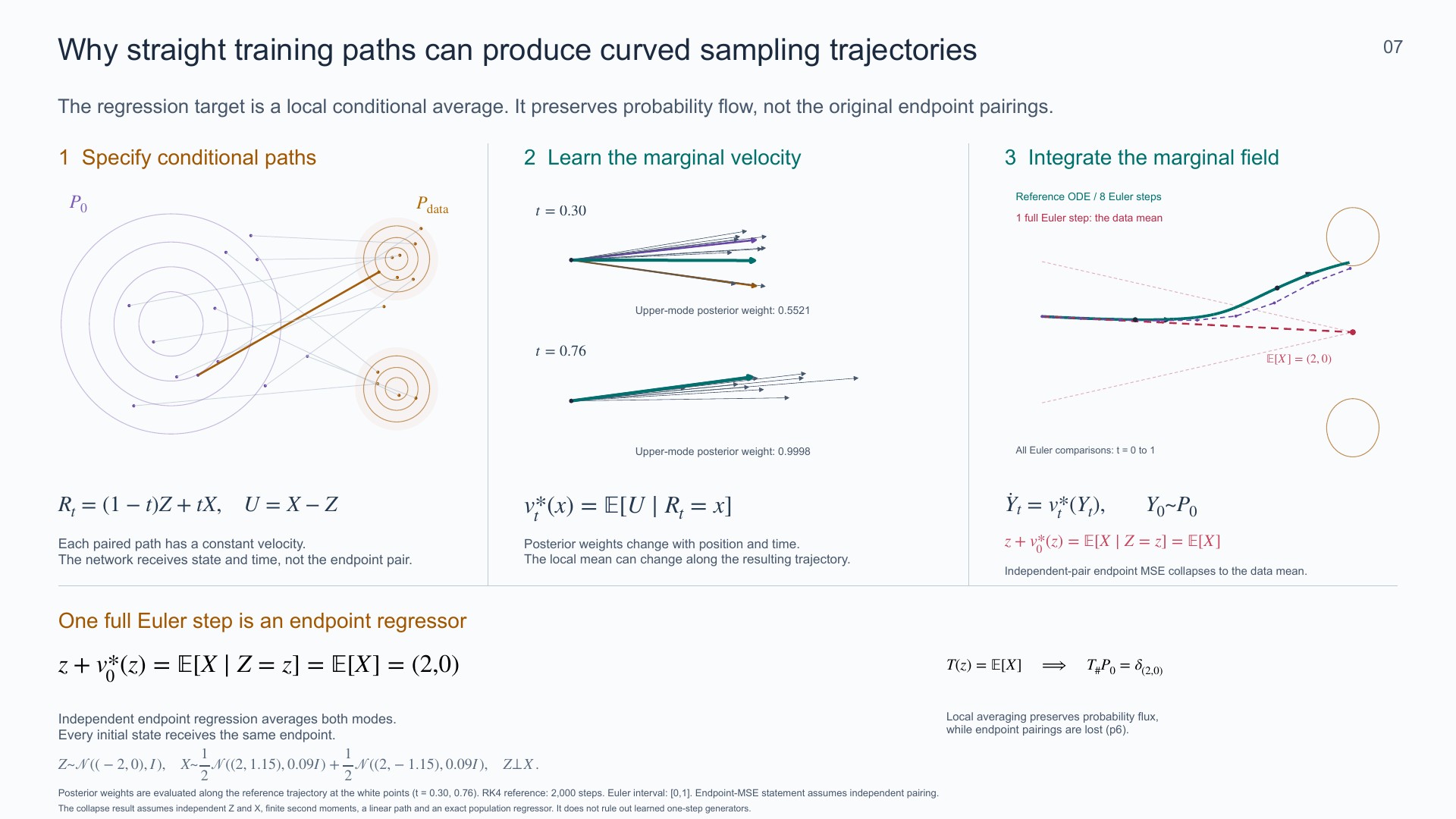
6. Why straight training paths can produce curved sampling trajectories
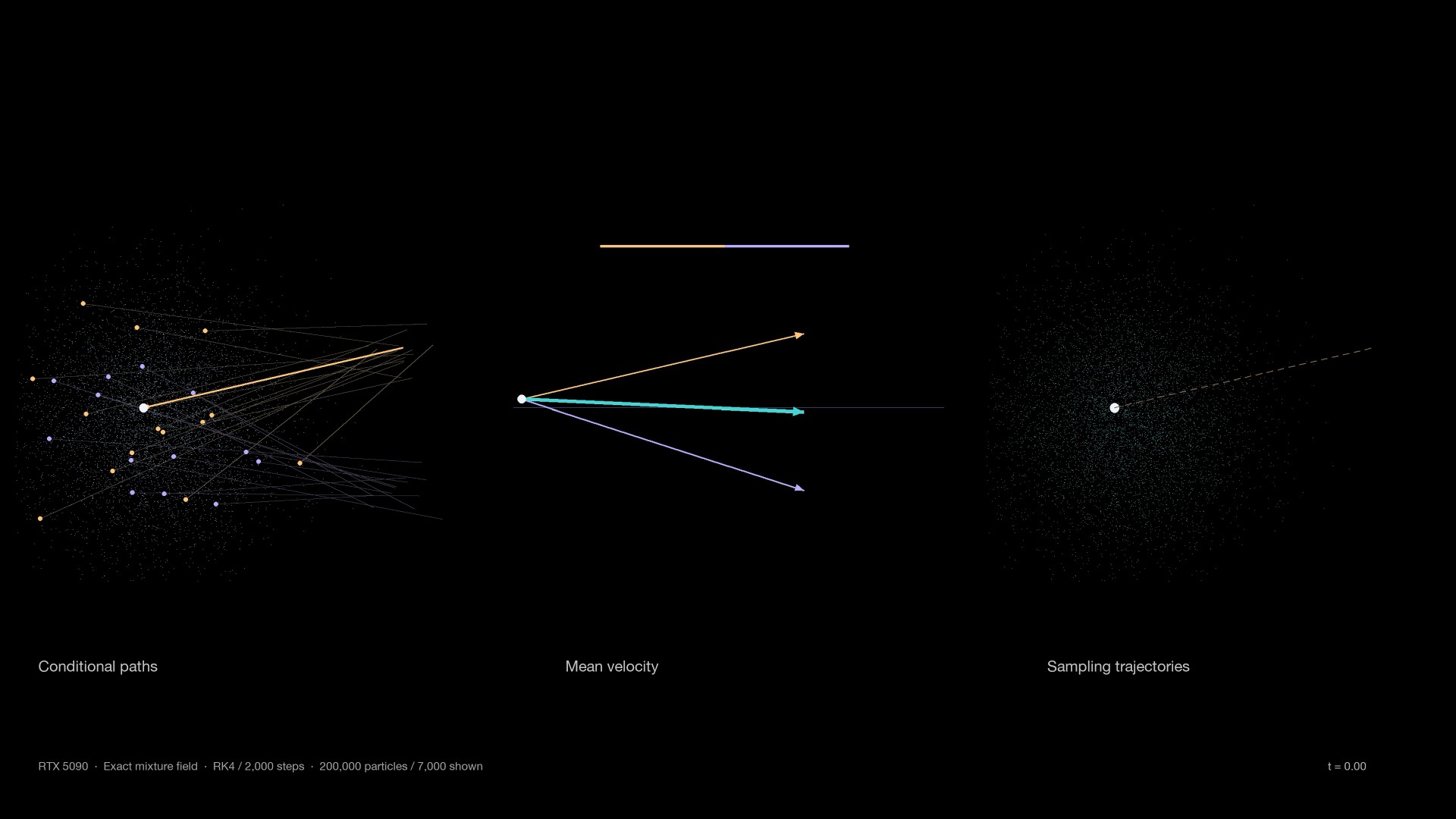
7. Conditional paths, mean velocity, and sampling trajectories
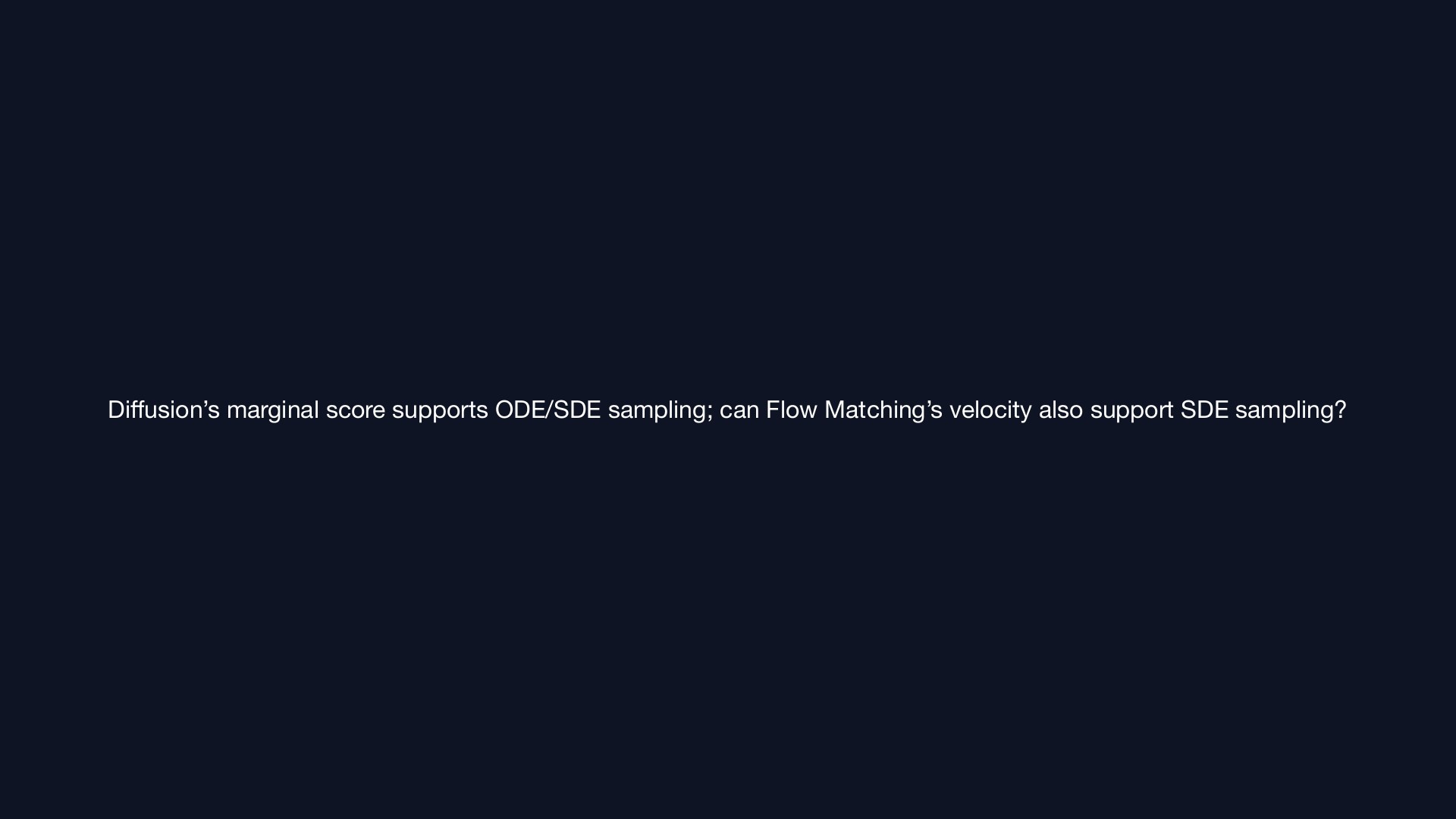
8. Can Flow Matching velocity support SDE sampling?
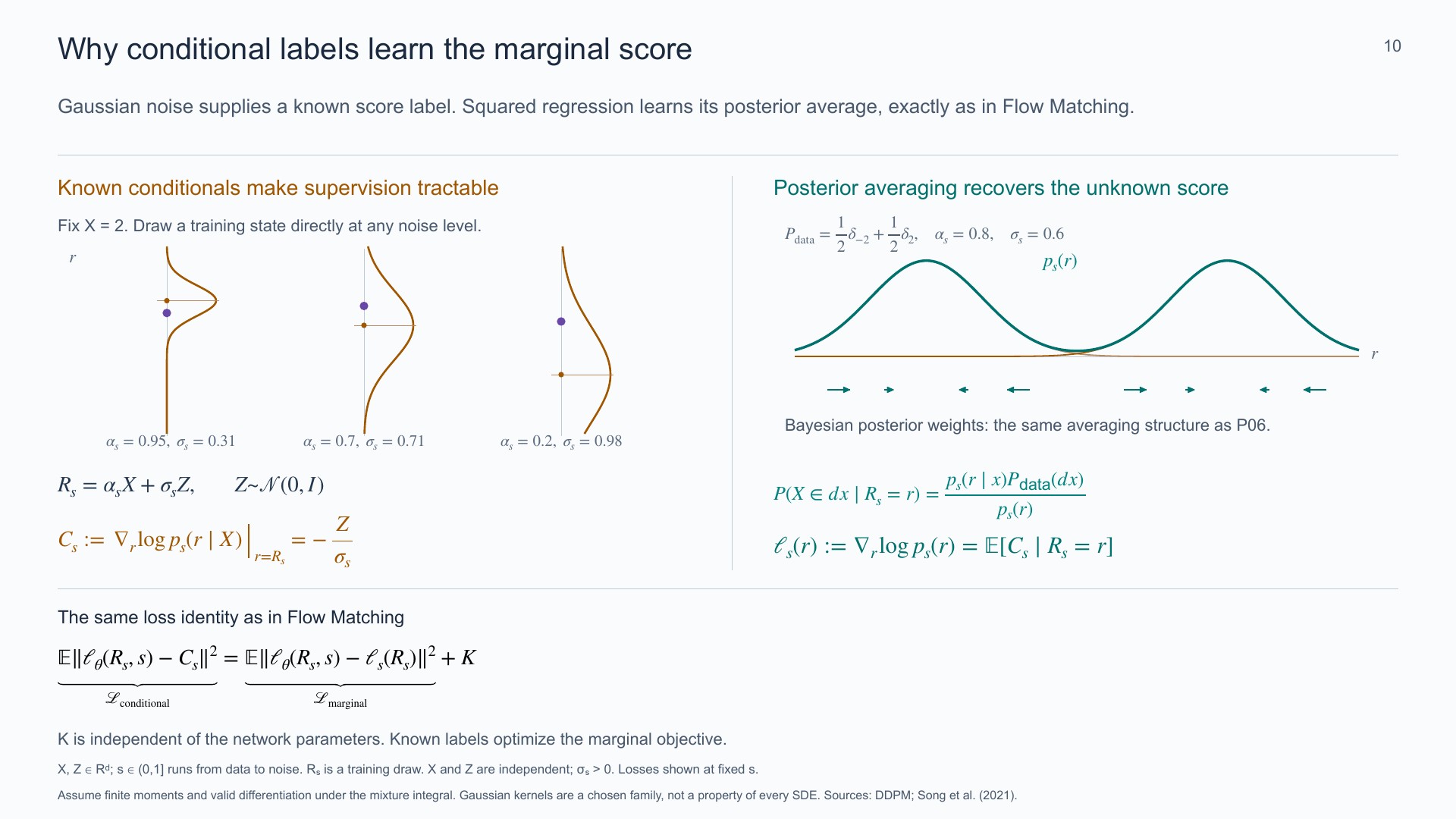
9. Why conditional labels learn the marginal score
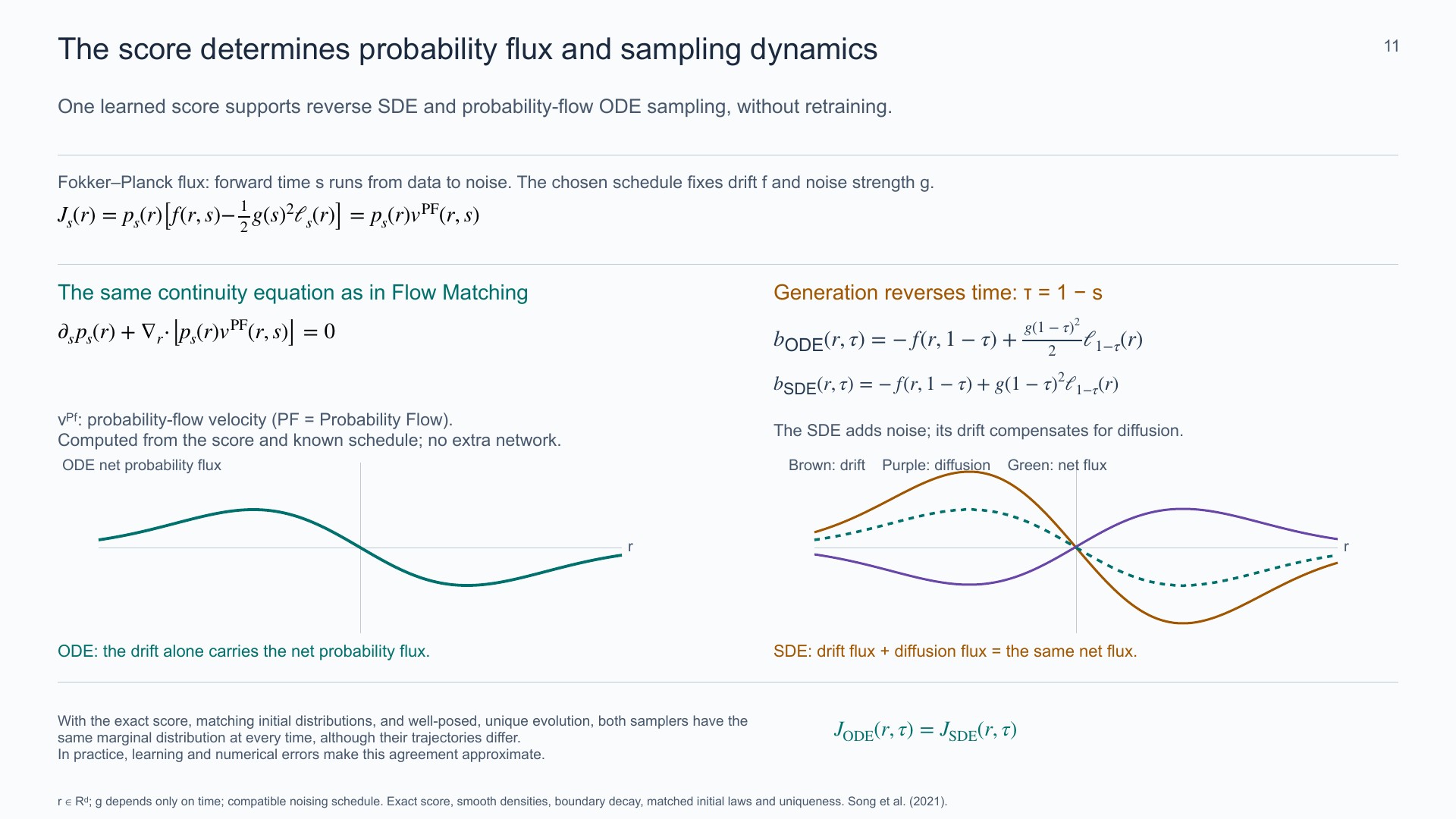
10. The score determines probability flux and sampling dynamics
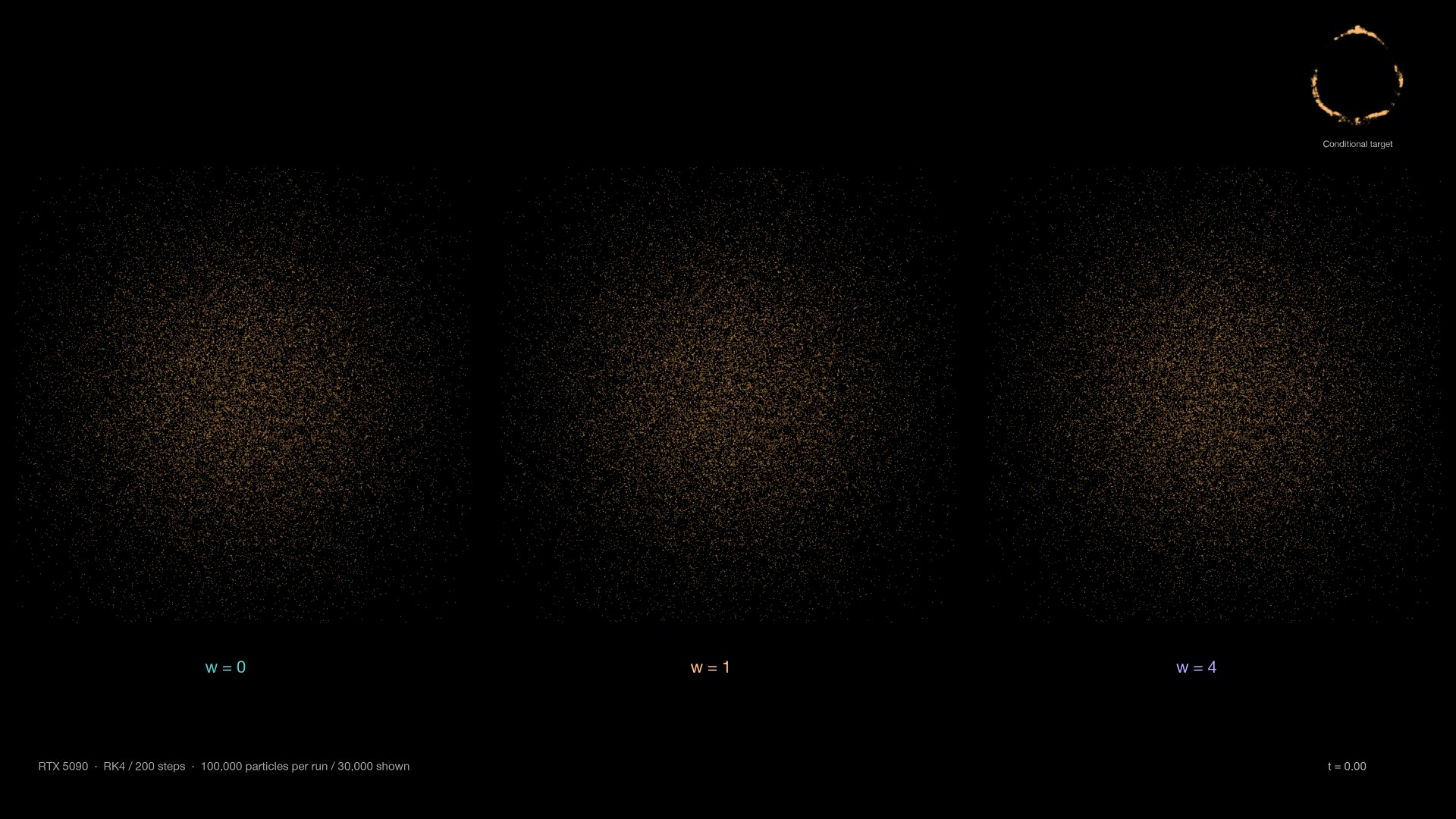
11. Conditional guidance demonstration
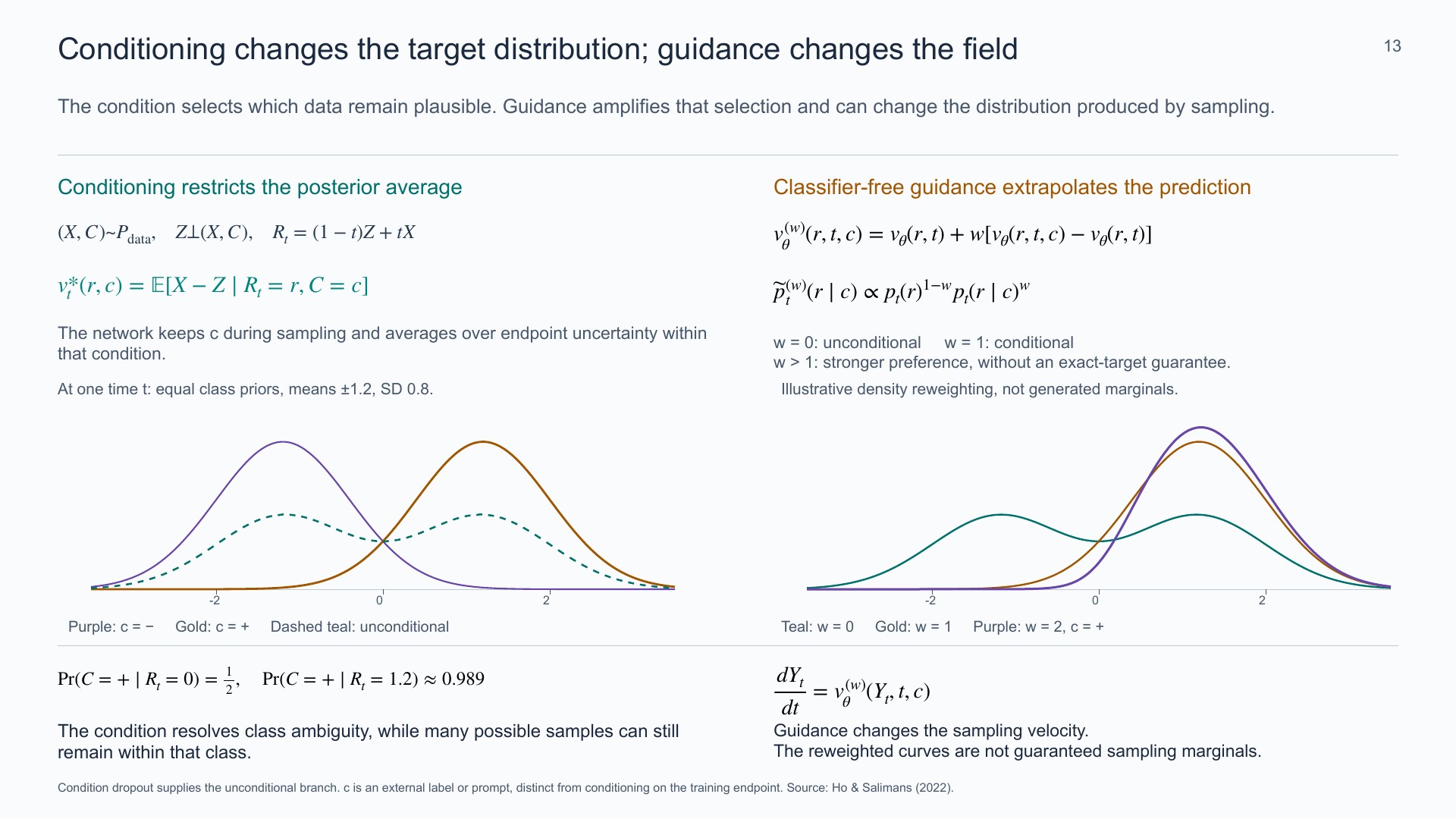
12. Conditioning changes the target distribution; guidance changes the field
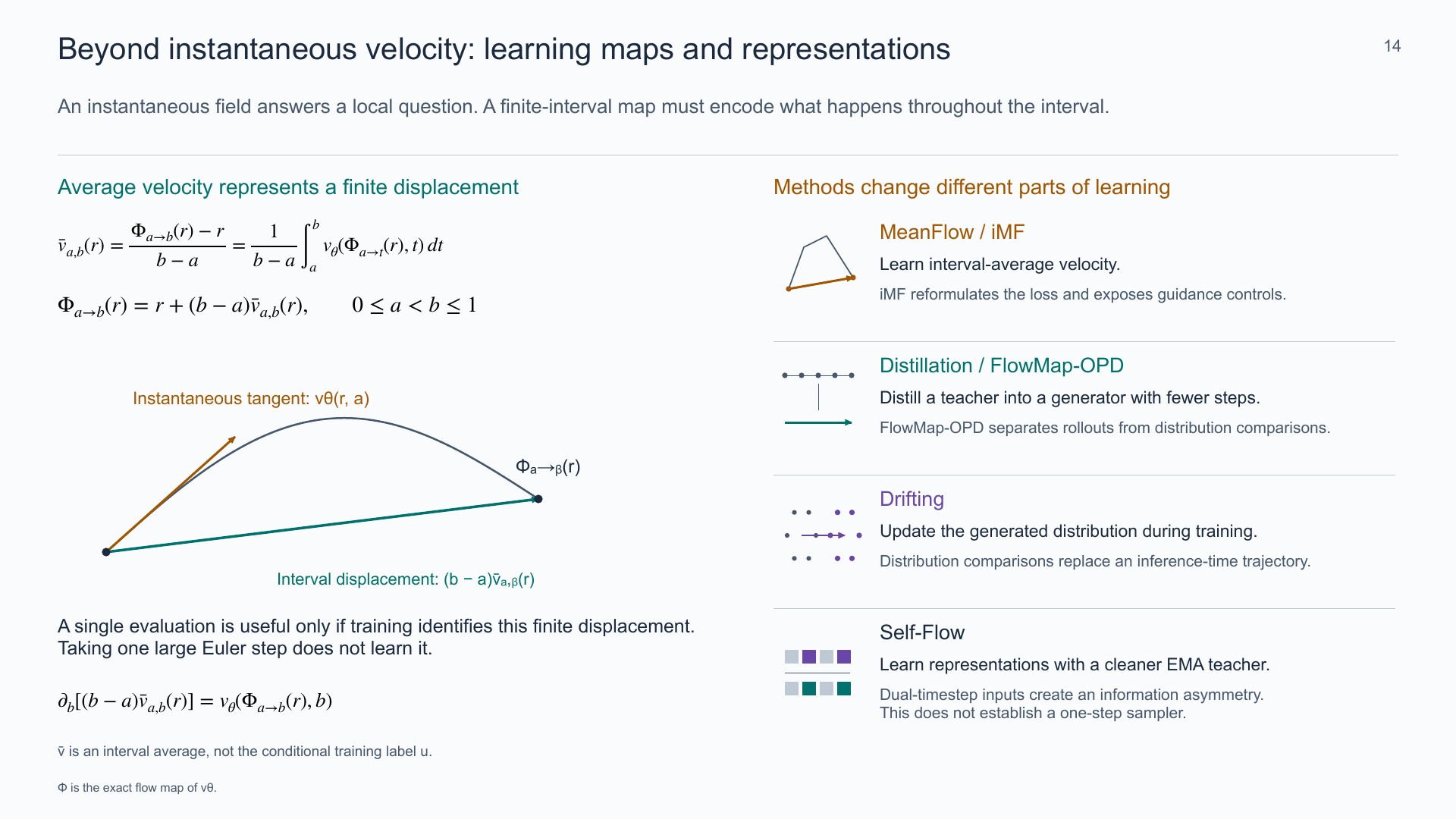
13. Beyond instantaneous velocity: learning maps and representations
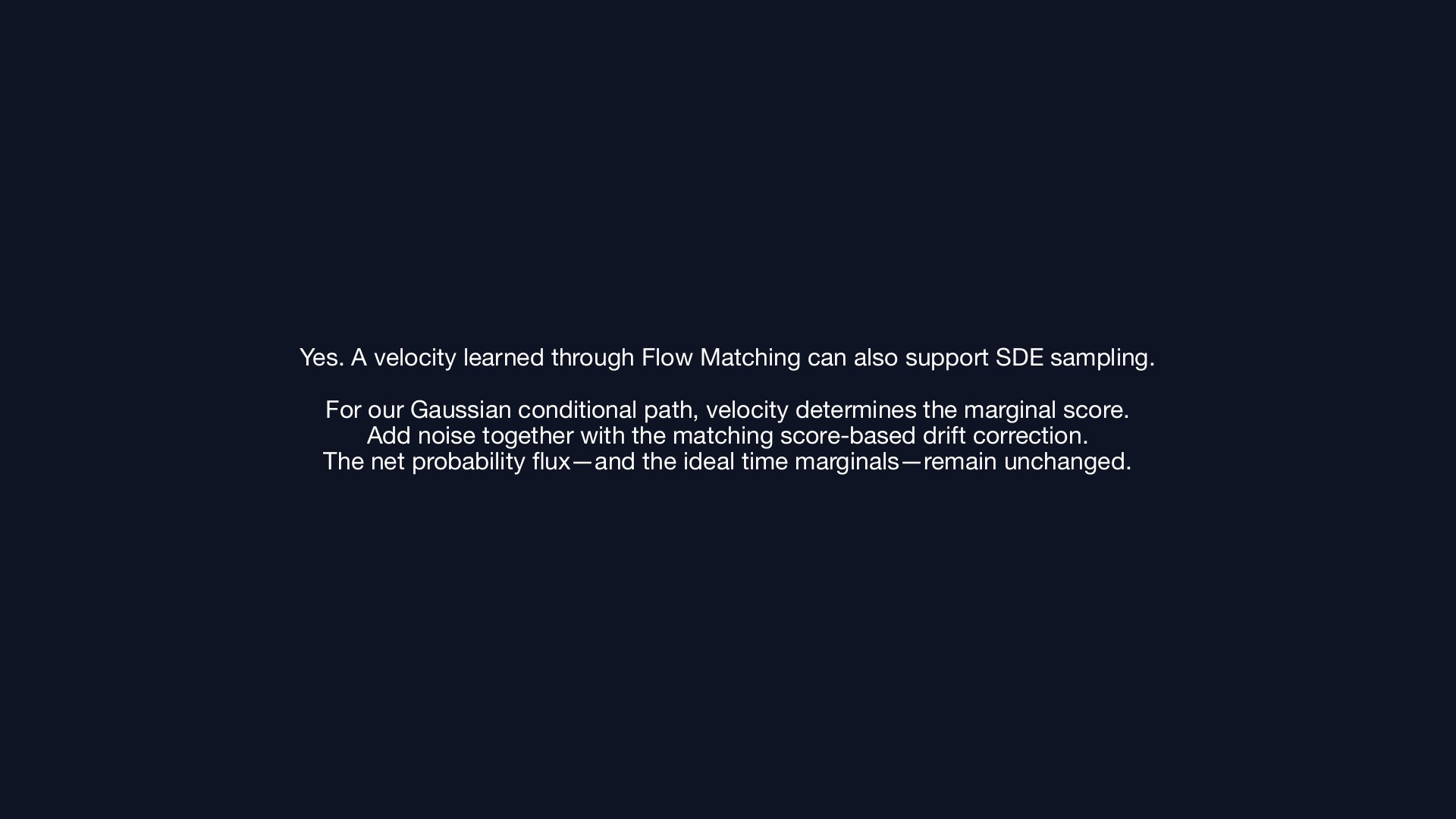
14. Flow Matching and SDE sampling
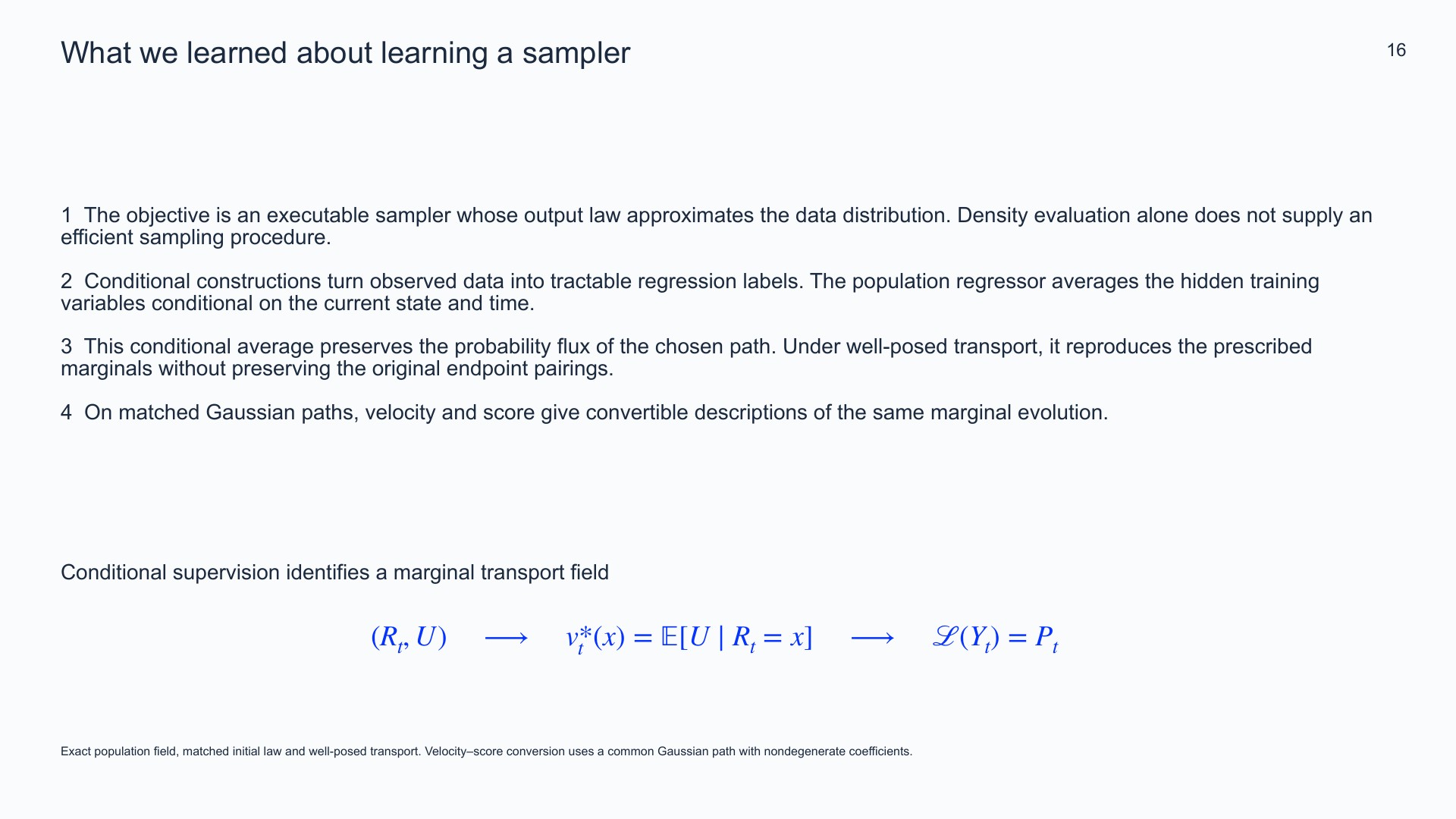
15. What we learned about learning a sampler
References and reading guide
The section numbers below refer to this webpage (1–15); the images retain the original deck's page numbers (02–16).
Flow Matching and continuous normalizing flows
- Start here: Lipman et al. (2024), Flow Matching Guide and Code. A comprehensive guide to the mathematical foundations, design choices, and implementation of Flow Matching. Relevant throughout sections 1–7 and 14–15.
- Lipman et al. (2022), Flow Matching for Generative Modeling. The main source for sections 4–6: conditional paths, the marginal velocity, and the equivalence of FM and CFM training gradients. See Sections 3–4 and Appendix B for the continuity equation.
- Chen et al. (2018), Neural Ordinary Differential Equations. Background for the continuous normalizing flow construction in section 1.
- Grathwohl et al. (2018), FFJORD: Free-form Continuous Dynamics for Scalable Reversible Generative Models. Background for likelihood-based CNF training and Jacobian-trace estimation in section 1.
Diffusion, scores, and ODE/SDE sampling
- Ho, Jain, and Abbeel (2020), Denoising Diffusion Probabilistic Models. Gaussian noising and denoising regression underlying section 9.
- Song et al. (2021), Score-Based Generative Modeling through Stochastic Differential Equations. The main source for sections 2 and 9–10: score estimation, the reverse-time SDE, and the probability-flow ODE. See Sections 3.2–3.3, Section 4.3, and Appendix D.1. Equality of ODE/SDE time marginals assumes exact fields, matching initial laws, and well-posed evolution; it does not assert equality of individual trajectories.
Conditioning and guidance
- Ho and Salimans (2022), Classifier-Free Diffusion Guidance. Conditional/unconditional prediction mixing underlying sections 11–12. The slides use a scale convention where 0 is unconditional and 1 is conditional; compare conventions when reading the paper. The density reweighting illustration is not a guarantee of the guided sampler's marginals.
Learning finite-interval maps and representations
These papers correspond to section 13. They address different training objectives; representation learning alone does not establish one-step sampling.
- Geng et al. (2025), Mean Flows for One-step Generative Modeling. Average velocity over a finite interval and its relation to instantaneous velocity.
- Geng et al. (2025), Improved Mean Flows: On the Challenges of Fastforward Generative Models. iMF's reformulated training objective and explicit guidance conditioning.
- Li and Zhu (2026), FlowMap-OPD: Rollout–Kernel Separation for On-Policy Distillation of Few-Step Flow-Map Generators. Separating student rollout states from teacher–student distribution comparisons.
- Deng et al. (2026), Generative Modeling via Drifting. Evolving the generated distribution during training to obtain a generator with one-step inference.
- Chefer et al. (2026), Self-Supervised Flow Matching for Scalable Multi-Modal Synthesis. Self-Flow's representation-learning approach and dual-timestep scheduling; the authors' project page links the paper and code.
Related notes and demos
- Diffusion Models Intro: extended derivations and background.
- Guidance and Classifier-Free Guidance: conditioning, guidance conventions, and their limitations.
- Flow Bedrock V2: companion demonstrations of learned transport and sampling.
Event
Diffusion Models: From Foundations to a Working Application — event page on Luma